
Many people don’t know it, but the Nouvelle-Aquitaine region is the historic birthplace of caviar in France. Where does it come from? How isAquitaine caviar produced? Where can you find it on the Bay of Arcachon? How much does it cost? Find out all you need to know about Caviar d’Aquitaine, the black pearl of French gastronomy!
Sturgeon, a fish with golden eggs
A rare and exceptional delicacy, caviar is the name given to the eggs of the sturgeon (Acipenser sturio), a migratory fish native to the Caspian Sea between Russia and Iran. Once abundant on our coasts, wild sturgeon virtually disappeared at the end of the 19th century, due to overfishing, poaching and pollution. As a result, wild caviar has been banned from sale since 2008. Today, sturgeons are farmed in ponds or lakes. A pioneer in this field, France has established itself as a major player on the world caviar market. And the historic birthplace of caviar in France is none other than the Nouvelle-Aquitaine region!
New Aquitaine, home of caviar
With 30 tons of caviar a year, France is the 3rd largest producer in the world, behind China and Italy. At the heart of this production, the Nouvelle-Aquitaine region alone supplies 24 tonnes! Breeding farms are mainly located in the south of the Gironde, along the estuary and the Arcachon basin, as well as in the Isle-en-Dordogne and Adour basins in the Gers. Renowned the world over for its firm texture, low-iodine taste and perfectly balanced salting, Aquitaine caviar is exported to Japan, Dubai, the United States and even Russia, the traditional mother country of caviar!
Precision work
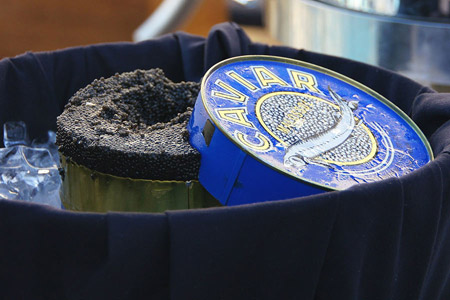
Caviar is produced using a rare and complex know-how. After extraction, the eggs are sieved by hand, sorted like diamonds by color and size (from 2.6 to 3 millimeters), rinsed in clear water, drained and then mixed with salt to become caviar. After the delicate salting operation, the precious grains are tinned and matured for several months in cold storage.
Why is caviar so expensive?
If caviar is sold at prohibitive prices, it’s because it’s rare! Producing quality caviar, such as that from the Arcachon Basin, requires specific know-how, but also a great deal of patience! From extracting the eggs, to salting and packing, each stage of production requires meticulous, repeated care. First of all, you have to wait three years to find out whether the sturgeon is male or female. Ultrasound scans are carried out regularly. The sturgeons are also weighed and measured every two months to make sure they have everything they need. By the age of 8, a female sturgeon weighs up to ten kilos and produces around 10% of her weight in caviar. And the price? A luxury product par excellence, caviar is very expensive, costing between 1,000 and 3,000 euros per kilo! In delicatessens, a small tin ofAquitaine caviar (30 g) is sold for around 30 euros. By contrast, Beluga Impérial d’Iran, the most expensive caviar in the world, fetches up to 12,000 euros a kilo!
Where to eat caviar on the Bay of Arcachon?
During your stay in the Arcachon Basin, why not indulge in a tasting of Aquitaine caviar? From April to the end of September, aquaculture farms open their doors to you. A local guide will show you the secrets behind the production of Aquitaine’s black pearl, including a tasting session.
– At Le Teich, L’Esturgeonnière has been breeding Siberian sturgeon since 1991 to produce Perlita caviar: take a behind-the-scenes look at an authentic fish farm, from reproduction to packaging, including the birth of fry and rearing in the various ponds.
– In Biganos, the Moulin de la Cassadotte is the first aquaculture farm in France to embark on the Siberian sturgeon adventure: guided tour of the sturgeon ponds, discovery of the history of the mill, introduction to caviar tasting.