
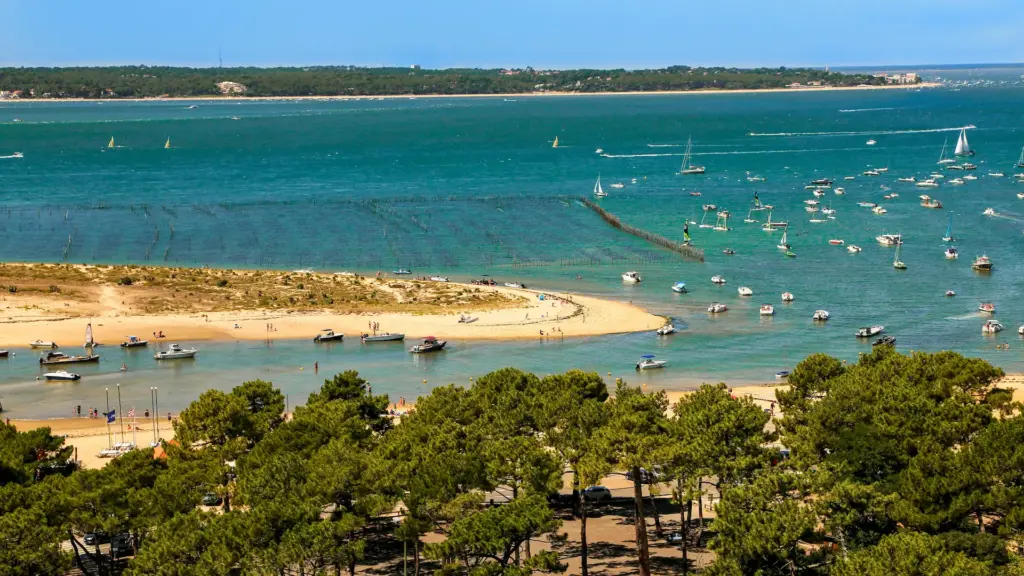
Did you know that the Bay of Arcachon is home to the largest seahorse population in France? This animal has even become one of the Bay’s symbols. Put on your flippers and your wetsuit, and we’ll take you diving with the seahorses in the Bay of Arcachon!
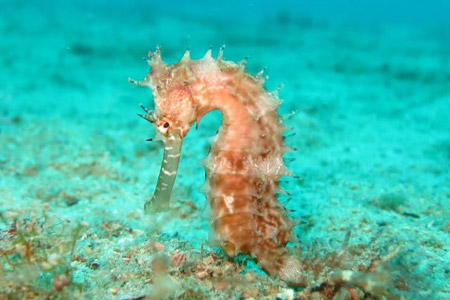
An intriguing, fascinating and little-known animal
The seahorse is one of nature’s most curious hosts. A rare and endangered species, it is abundant in Lac d’Hossegor(Landes) and Etang de Thau(Hérault), but the Bay of Arcachon has the highest concentration in France. So much so, in fact, that the seahorse has become one of the Bay’s emblems. In fact, it is the symbol of the town of La Teste-de-Buch.
7 things you (maybe) didn’t know about the hippocampus
Seahorses, those discreet and atypical little creatures, hide their game well. Here are 7 things you need to know about this little-known, yet 40-million-year-old marine animal.
1. Contrary to appearances, the seahorse is a fish. It belongs to the syngnathidae family of bony, elongated fish. The seahorse has no scales, but is covered with bony plates that serve as armor.
2. The seahorse is nicknamed the “sea horse” because of its horse-like head. In Greek mythology, the seahorse is considered a fantastic creature, half-horse half-fish. In fact, its scientific name derives from the ancient Greek Hippókampos: hippo (horse) and kampos (sea monster).
3. In seahorses, the male carries the babies. The female entrusts him with her eggs, which are fertilized in a ventral pouch.
4. The seahorse has no teeth. It sucks up its food with the help of its straw-like mouth. Its diet consists exclusively of small crustaceans, larvae and plankton. Seahorses have no stomach, so they must feed very often.
5. The seahorse swims vertically and moves very slowly thanks to its dorsal fin. It takes 5 minutes to cover 25 centimetres. Its pectoral fins enable it to steer. Its tail, curled at the tip, enables it to cling to any surface.
6. Like the chameleon, the seahorse’s eyes move independently, giving it greater visual acuity than the average fish. A definite advantage, given that the seahorse has no defence against predators.
7. The lifespan of a seahorse is 2 to 4 years, whether in its natural environment or in an aquarium.
Focus on the speckled seahorse
Two species can be found in the waters of the Bay of Arcachon: the short-snouted seahorse and the speckled seahorse (Hippocampus guttulatus). The latter is the most widely observed species. It’s also known as the long-snouted seahorse. It is covered in white spots. Its adult size varies from 7 cm to 15 cm. In the past, fishermen who caught this line of seahorses in their nets dried them before selling them to tourists as souvenirs.
Where and how to see seahorses on the Bay of Arcachon?
Although there are thousands of seahorses in the Basin, they are not easy to spot. They live in eelgrass beds, underwater meadows that proliferate at depths of up to 10 meters. The Bay of Arcachon is home toEurope’s largest eelgrass beds.
Professional diving centers offer themed dives to observe these fascinating creatures. In any case, whether alone or accompanied, don’t touch seahorses. Although they are not shy and are easily approached, they are extremely fragile.
- OCEANA, diving center and school: 14 rue du Capitaine Allègre, 33120 Arcachon, tel.: 06 72 78 28 74, website: www.oceana.fr/
- Club de Plongée Arcachonnais: Maison de la Mer, Quai Goslar, 33120, Arcachon, tel.: 07 66 08 22 72, website: www.club-de-plongee-arcachonnais.pepsup.com/
- Hippo diving school: 60 route du Cap-Ferret, Grand-Piquey, 33950 Lège-Cap-Ferret, tel.: 06 16 63 75 24, website: www.plongeehippo.com
Is it safe to eat seahorses? Seahorses are not intended for consumption. However, in China and South-East Asia, seahorses are much sought-after as a traditional remedy for many illnesses, but also for their alleged aphrodisiac virtues. On the market, their price can reach up to 1,000 euros per kilo!
photo@Arhnue Tan/pixabay