
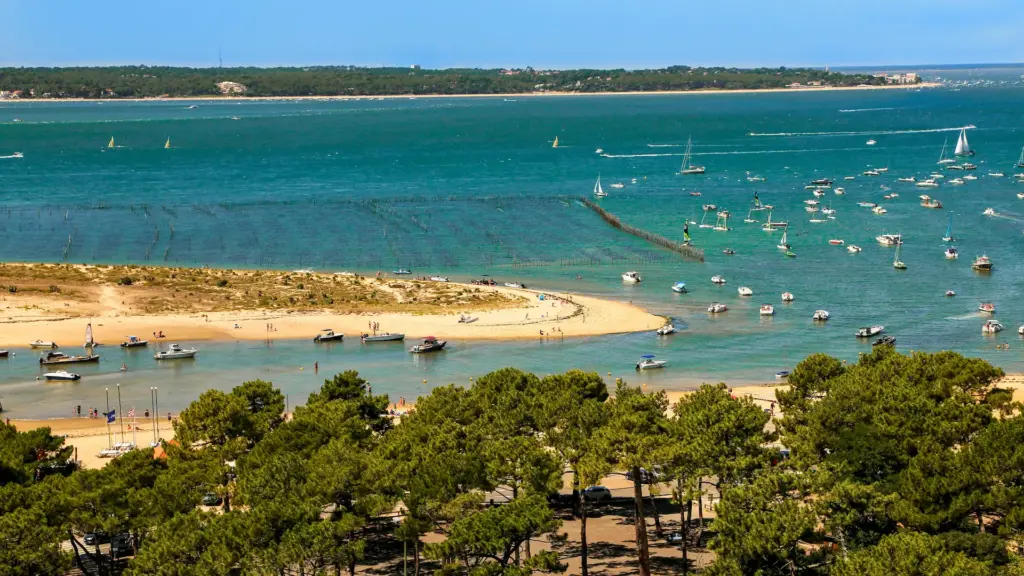
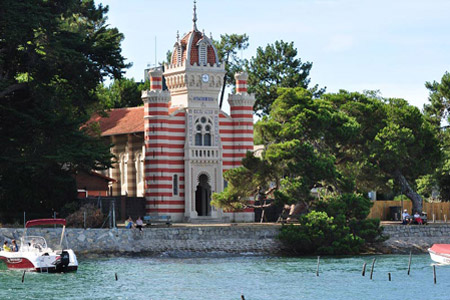
On the Cap Ferret peninsula, just a stone’s throw from a small beach on the Bay of Arcachon, a footpath leads in just a few minutes to the foot of an astonishing chapel. It’s so anachronistic in the landscape of the small oyster-farming village of L’Herbe that it makes a lasting impression. The Sainte-Marie-du-Cap chapel is a one-of-a-kind edifice built in 1885 by Léon Lesca, a wealthy French entrepreneur and philanthropist with a passion for Moorish culture.
Once upon a time… the Algerian Villa
It all began in 1864, with the construction of Monsieur Lesca’s Algerian villa. A native of La Teste-de-Buch, Léon Lesca was a public works contractor who became famous for his part in the construction of the port of Algiers. On his return from Algeria, where he had lived for several years, the Gironde industrialist bought a large plot of land at a place called “Gnagnotte”, at the entrance to the village of L’Herbe. At the time, it was just a vast field of dunes and pine trees lost between Claouey and Bélisaire. It was here that Léon Lesca had his “oriental dream in a sandy desert” built between 1865 and 1885, which he christened the “Villa algérienne”.
Topped by a large cupola and pierced by intersecting arcades, Léon Lesca’s Algerian villa was inspired by the “orientalist” style that was very much in vogue on the Bassin d’Arcachon at the time. A magnificent 25-hectare exotic garden planted with palms, yuccas and mimosas surrounds the villa, nicknamed “Le Palais des Pachas” by the inhabitants of Cap-Ferret.
General Councillor for the canton of La Teste for twenty-five years, Léon Lesca lived here until his death in 1913 at the age of 88. At the end of the 1950s, the estate was bought by hoteliers who transformed “la villa des Pachas” into a bar-restaurant (Le Five O’clock Tea). In 1965, having been abandoned by its owners, the Villa Algérienne was sold to a real estate developer, who immediately had the building razed to the ground in order to build an apartment block. The chapel of Sainte-Marie-du-Cap, known as the Algerian Chapel, is today the only remaining reminder of the grandiose complex built by Léon Lesca.
The Algerian Chapel: an oriental fragrance in the heart of the Basin
After building the Algerian villa, Léon Lesca undertook the construction of a chapel, just like his little palace in the Thousand and One Nights, in the same neo-Moorish style that saw the light of day in Algeria in the 19th century.
He entrusted his architect friend Eugène Ormières, who had drawn up the plans for the Villa Algérienne a few years earlier, with the task of bringing the project to fruition. An astonishing neo-Moorish chapel emerged from the sand in 1885. It was the first church to be built in Cap-Ferret. It soon became a place of worship for the inhabitants of the surrounding villages. Previously, people had to cross the Bassin by pinasse to get to mass in Arcachon.
Flanked by two minarets and crowned by an astonishing bell tower surmounted by a Latin cross and a crescent moon, the chapelle Mauresque de l’Herbe borrows its ochre and brown renderings, ceramic tiles with geometric and floral motifs, star tiles, horseshoe arches and openwork columns from Arab-Muslim architecture.
Listed as a historic monument since 2008, the chapel was completely renovated in 2011. Today, masses, weddings and occasional christenings are celebrated here. In summer, the chapel hosts classical music concerts.
Practical info
- Address: Boulevard de la Plage, 33970 Lège-Cap-Ferret (village de l’Herbe).
- Open all year round, from 10am to 4pm.
- Information: 05 56 03 84 00 (Lège-Cap-Ferret town hall)
Also worth reading: What to see and do on the Cap-Ferret peninsula?
photo© Bernard Blanc, CC by-sa 2.0, Flickr