
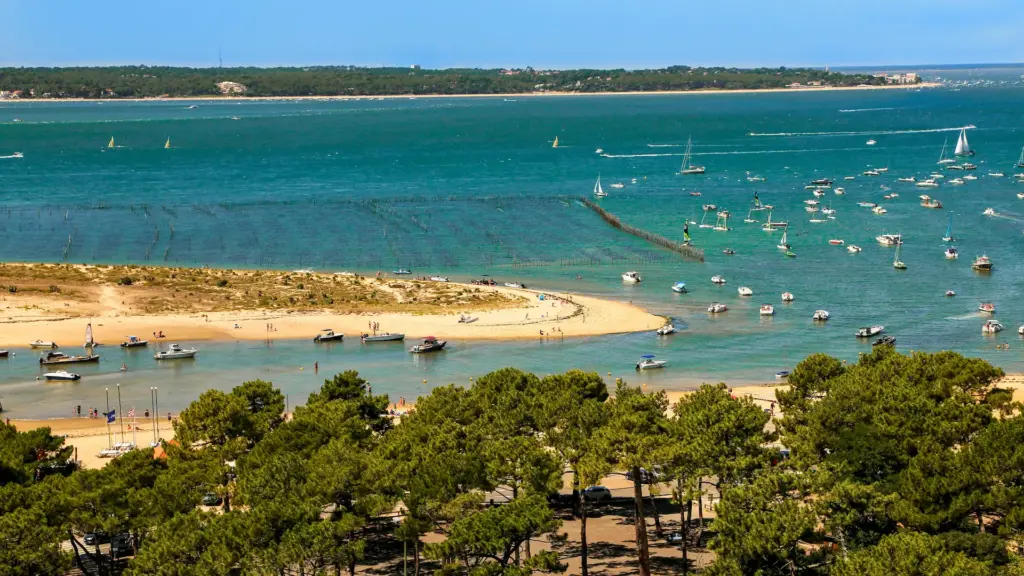
Water never stays still on the Bay of Arcachon! Twice a day, the lagoon empties and fills. These are the tides! It’s impossible to swim anywhere at any time. The same applies to sailing, fishing and water sports. We explain everything you need to know about the tidal phenomenon, as if you were there!
Why does the sea rise and fall?
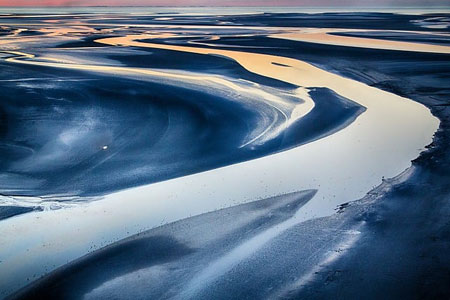
If you think the sea moves back and forth because of the wind or the waves… you’re wrong! The phenomenon of tides is due to the action of the Moon and the Sun. These two stars exert an invisible force on the ocean: gravitational attraction. Rather like a giant magnet, the Moon draws the water towards it. As a result, the water rises, forming a high tide. As the Earth rotates around itself in 24 hours, we pass through a high tide twice a day and a low tide twice a day. This is why, every six hours, the sea rises and falls on the Bay of Arcachon, as elsewhere on the planet. In just a few hours, the Bay’s landscape changes radically: sandbanks spring up, oyster beds appear, swarms of birds come to feed in the esteys and channels. The small inland sea shrinks from 155 km2 at high tide to 40 km2 at low tide!
High tides on the Bay of Arcachon
Depending on the respective positions of the Moon and Sun in relation to the Earth, tides are stronger or weaker. This amplitude is measured by the tidal coefficient, which ranges from 20 to 120. The higher the coefficient, the further the sea recedes at low tide and the higher it rises at high tide. Coefficients above 70 are referred to as “spring tides”. At full moon and new moon, coefficients explode: these are high tides! The water rushes through the Bassin’s “passes” and the currents become impressive. High tides” occur when the coefficient exceeds 100, usually twice a year, around the spring and autumn equinoxes. >> Consult the tide calendar to find out about the next high tides in the Bay of Arcachon.
The Arcachon Basin: a unique case!
The tides in the Bay of Arcachon are slightly out of sync with those of the Atlantic Ocean. This is mainly due to the geographical configuration of the basin, which is connected to the ocean by a narrow opening. At Arcachon, the water rises for 6 to 7 hours and falls for 5 to 6 hours. At Cap-Ferret, the tide comes in faster than at Arcachon. At the port of Le Teich, at the bottom of the basin, high tide can be about an hour later than at the entrance to the basin.
Arcachon Basin passes: beware of danger!
At each tide, between 200 and 400 million cubic meters of water flow in and out of the lagoon, generating powerful currents that continually alter the course of the passes (channels through which the lagoon empties) and the position of the sandbanks at the mouth. These constant movements make navigation particularly dangerous at the entrance to the lagoon. Before embarking on a boat crossing, it’s important to check with the harbor master’s office for the day’s conditions.
What to do at high tide: it’s time to dive!
High tide is the perfect time to :
- Swimming on the Bassin’s supervised beaches. From the Dune du Pilat to the tip of Cap Ferret, over 70 km of beaches await you.
- Take a canoe trip on the Leyre delta (departure from the ports of Biganos and Le Teich).
- Take a boat trip around Île aux Oiseaux (departure from Arcachon, Andernos and Lège-Cap-Ferret).
- Surfcasting: the rising tide is the most interesting time of year for seaside fishing. Surfcasting uses special equipment to catch sea bass, sole and bream behind the waves.
>> Tip: check the tide tables before setting off by boat or paddle, as some areas become impassable at low tide! After a day full of discoveries on the Bay of Arcachon, what could be better than a stay in the heart of nature? Discover our campsite and book your stay now! Whether you opt for a camping pitch, mobile home or chalet rental, you’ll feel like you’re in the middle of nowhere!
What to do at low tide: explore the foreshore and go fishing on foot
At low tide, the Bassin reveals a completely different face. It’s the perfect opportunity to :
- Observe the flora and fauna: at low tide, the esteys and channels reveal their secrets to walkers twice a day. Guided tours with a naturalist are organized during the school vacations. And it’s “vasement bien”!
- Crabbing and shellfishing, a popular family activity. Don’t forget to pick up a measuring ruler at the tourist office to ensure you respect the catch sizes!
- Swimming… at low tide? Yes, it’s possible! Head for the bathing basins at Lanton, Arès, Le Teich or Audenge, Europe’s largest seawater basin! Fed by the waters of the basin, these seawater pools allow you to enjoy a swim even at low tide.
Baïnes: those invisible traps
Small pool at low tide, baïne at high tide – beware the danger! Baïnes are natural “basins” formed by the movement of the tides and visible at low tide. When the sea rises, these pools fill up, creating a powerful current that can carry swimmers out to sea. Every year, baïnes are responsible for drownings. The ocean beaches of Lège-Cap-Ferret and La Teste-de-Buch are particularly affected.
If you are swept away by a bay:
- Don’t fight the current, let it carry you along to avoid exhaustion.
- Swim parallel to the beach to get out of the current.
- Wave to helpers so you can be spotted.
photo/pixabay