
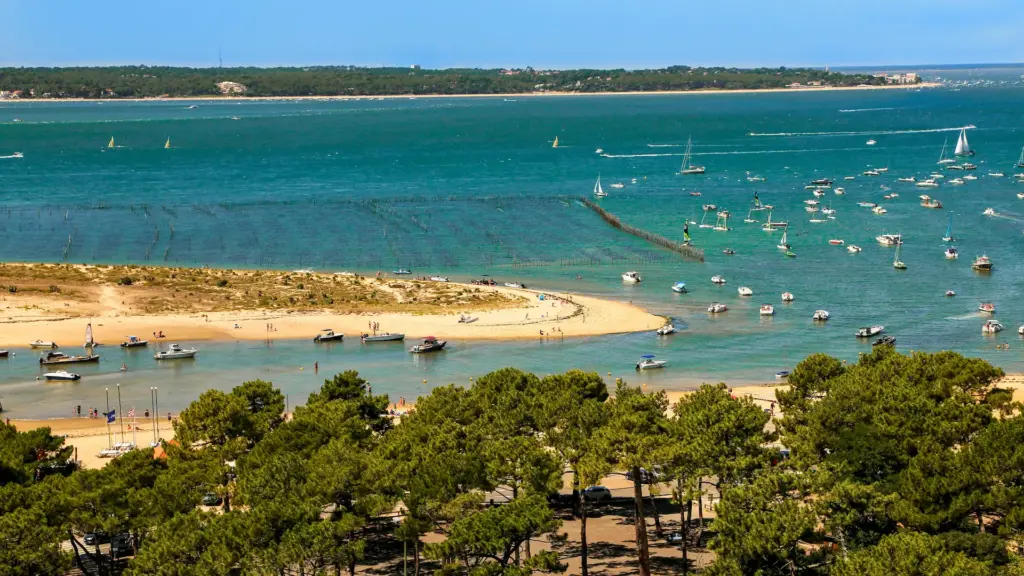
In Lanton, on the shores of the Arcachon Basin, a small museum of folk arts and traditions recalls the golden age of the gemmaker in the Landes and Gascony forests , a trade that has now almost disappeared… or is. Discover it!
Vintage in all its forms
To discover this typical little museum devoted to old trades, you need to go to the oyster port of Taussat-les-Bains in Lanton, 20 km from Le Ker Helen campsite. It’s here that the Gardarem eco-museum brings back to life the trades and rural life of yesteryear. If you’re not familiar with the language of Bernard Manciet, Gardarem means “we’ll keep” in Gascon. A fitting name for this museum, which aims to preserve the memory of Occitan heritage, ancestral know-how and the trades of yesteryear.
Created in 1998 by Jean Louis Lapeyre, a schoolteacher from Lanton, the Gardarem eco-museum presents over 600 old tools and objects used by our ancestors. Pell-mell, you can discover an old waffle iron, a cast iron, a stove with a large handle for the fireplace, a shucker for opening oysters, a peeling weeder, a pearl weaving loom, an antique “Calor” toaster? In short, vintage and collectors’ items! Like a giant toolbox, this bric-a-brac from bygone days tells us about the agricultural and artisanal activities of the Bay of Arcachon, from oyster farming to hunting, fishing and gemmage. We’d like to take a closer look at the latter.
A profession, a story: the gemmaker
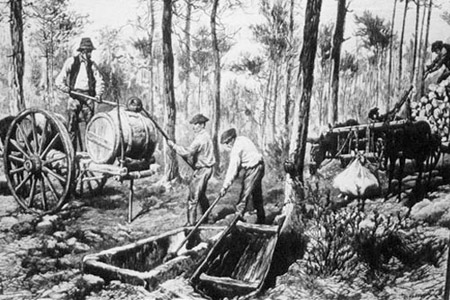
The gemmeur was the person who harvested the resin from pine trees, known as gemme, not to be confused with the sap of the pine, which circulates in the tree between the roots and the leaves. Resin, on the other hand, is found around the edges of the tree.
At the time, pine resin was highly prized. It was used to make turpentine and rosin loaves (or arcanson in Gascon, from which the town of Arcachon derives its name). For a long time, rosin was used to make printing inks, rubber, glues and varnishes, sealing waxes, chewing gum paste and violin string polish. It is also used in the cosmetics and pharmaceutical industries, and more pragmatically, for caulking boats.
Resin harvesting
To harvest the precious nectar, the gemmistress cuts into the tree’s bark. To heal the wound, the pine secretes a sticky resin which flows into a terracotta pot hung along the edge (the wound).
Gemmage is an ancestral activity dating back to Gallo-Roman times. The practice became widespread on an industrial scale in the 17th century, before becoming commonplace in the Landes de Gascogne in the mid-19th century, when Napoleon III decided to enlarge the forest to fix the dunes and rehabilitate marshy soils. This was the “time of the golden tree”. Resin became an international commodity. Gumming became a major economic activity, mobilizing entire families and employing hundreds of people in Gironde.
The gemmaker’s trade lasted until the 1960s, when it declined. The reason: the arrival of synthetic resins on the market, and competition from Portuguese and Chinese gemmakers. At the time, there were still over 16,000 gemmakers, but by 1990 there were none…
Gemmaking demonstration
Even if the tradition of gemmage has disappeared from our landscapes, it is no less rooted in local heritage and memory. In the forest of Lanton, Valentin Bonfils, naturalist guide from the Nature Gasconne association , revives the memory of gemmage on the Arcachon Basin. During the summer, he retraces the history of the activity and reproduces the gestures of the gemmeur using traditional tools such as the hapchot, an axe with a curved edge, and the escouarte, the cylindrical container used to collect the resin. Registration at the Coeur du Bassin tourist office (mid-May to late September).
Did you know?
Gemmeurs and resin makers are often confused: the resin maker is the person who transforms the resin in a distillation plant.
Practical info
- Access: Port de Taussat, 2 allée des Cabanes, 33138 Lanton, tel. 06.63.58.78.81
- Visits Saturday and Sunday, 5 pm to 7 pm (free)
- Further information: www.gardarem.fr